


Are you 100% sure of the profit you make on every case you sell? Not your margin over landed cost - your real profit after the deviation from the GPO contract, the trade check from the co-op, and the local deal you cut with the broker in March.
An executive who spent 30 years at Sysco recently told us he'd known that number every day, until he moved to an independent and found that they didn’t have it. So he called around, but nobody he knew had it either. He'd assumed it was a local problem - It's the industry.
That's the gap the big three actually exploit - the ability to calculate, down to the case, what a product nets after every dollar coming back from the manufacturer, and a sales force that prices from that floor. Most independents price from landed cost plus a margin and hope the back-end money shows up in the wash three months later.
Today we're introducing Billback Agent, the first step toward closing that gap. It automates the monthly work of matching every operator-level sale to every GPO contract the distributor is entitled to bill back on, surfaces the deviation dollars being missed, and shows the sales team exactly where more is available.
To see why that matters, let’s start with the number it's building toward: Net Item Value.
Net Item Value
Net item value is what a case actually earns the distributor after every dollar of manufacturer money is counted. The Big 3 know it on every SKU, but almost no independent does - they have the right data, but it lives in three places that never meet.The invoice says ten dollars. The truth is $14.70, and that’s 47% more profit than anyone in the building can see. Multiply that across a category, and net item value is what tells you that Supplier A is your most profitable french fry, with Supplier B in second, and the other five brands in the freezer are costing you money you already earned.
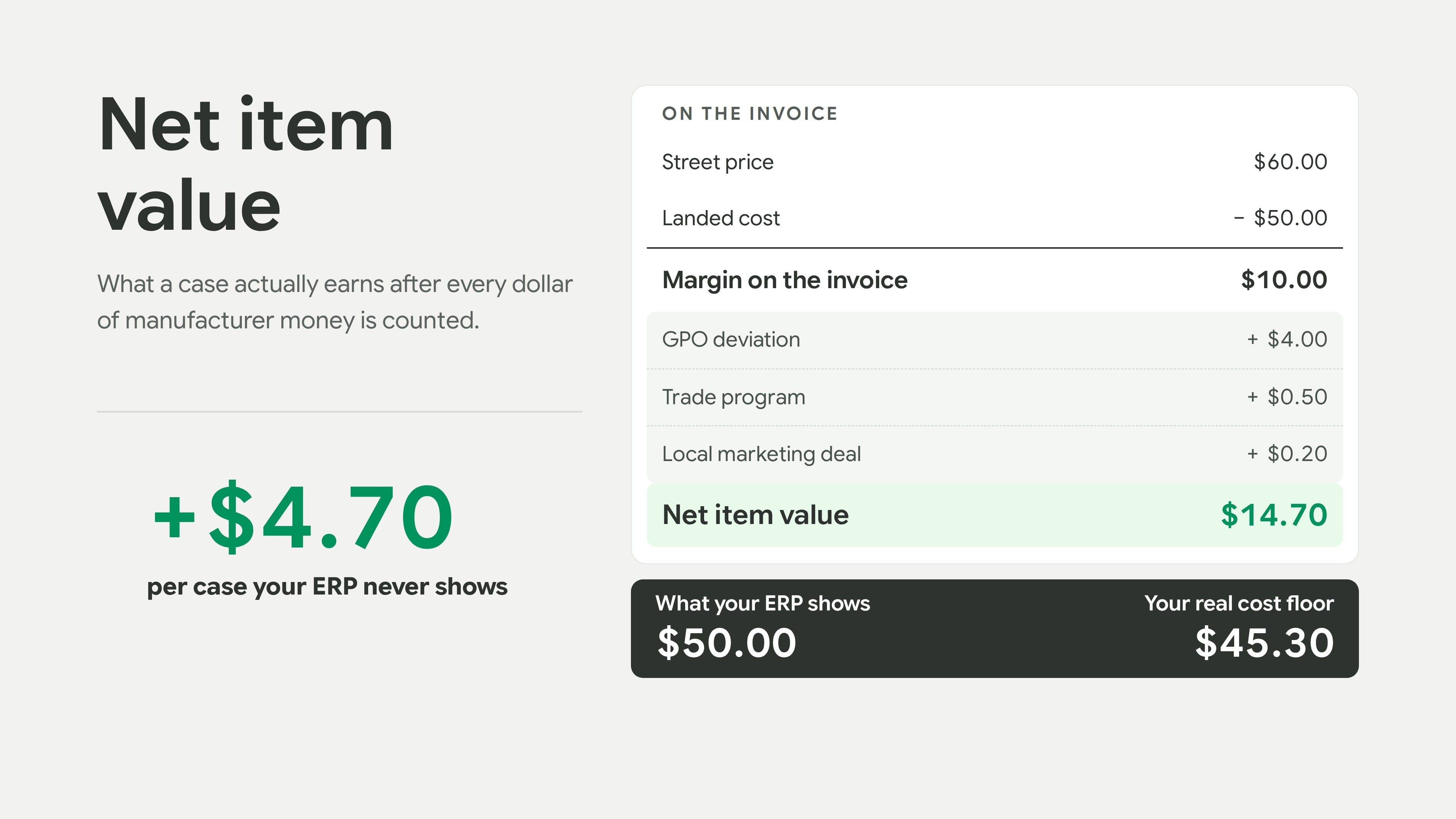
That's the number that lets Big 3 reps hold a price a point below yours and still make more on the case. It's not simply a scale advantage. It's an information advantage, and it's the one independents can close.
Why the GPO Bucket Leaks
Capturing GPO deviations means matching every sale against a file of roughly 45,000 contracts that changes monthly and sometimes mid-month. At one large distributor, that's a 30-person contract team. At a mid-market house, it's one person and a stack of spreadsheets. At a $15M distributor that just joined a GPO, it's nobody - they learn what an exclusion is when the first rebate arrives.
And the data is dirty:
- Missing GTIN data because distributors may not keep them in the ERP
- Dirty data, a GTIN missing a digit marks a rebate invalid
- Supplier Mis-matching - A Tyson item that shows up in the ERP as Dot Foods because that's who shipped it.
Every mismatch is a case sold on contract that never gets billed back. Distributors who've done this for years are confident their process is buttoned up, and they're mostly right.. But "mostly" on 45,000 changing contracts is real money.
Where Pepper’s Billback Agent Fits In
Billback Agent is simple: It automates the rebate bill-back process for distributors participating in group purchasing programs.
How it works:
- The distributor loads what already exists (exclusions, tier logic, PO cost, and the contract file), and sales data comes from the Pepper integration already in place.
- The pipeline matches every sale to every eligible contract, confirms the clean matches, and surfaces the fuzzy ones with a confidence score for a human to approve or reject. Every decision is remembered, so the review list shrinks every month.
- Outputs go wherever the distributor already works - a TrackMax or Speedy Labs file, a pricing file for the ERP, or an invoice spec straight to the manufacturer.
Billback Agent shows which current operators are buying contract items but aren't enrolled with the GPO, with the deviation dollars attached to each account. Not only that, but it shows where the distributor is moving a lower-deviation brand when a higher-deviation equivalent exists in the same category - the first real view of net item value by brand, and the conversion list a sales manager has never had.
A Real-World Use Case
One of our design partners had managed GPO contracts for years with a working process. Running Billback Agent against the same sales data, monthly billbacks rose 74%.
Going back over months already billed, the contract manager found another $14,000 still claimable inside the three-month window. And the brand analysis surfaced roughly $150,000 in annual deviation behind 14 high-volume items in one category available if operators moved from one french fry to another. Their sales team has since converted 48 of 224 target operators.
None of that was necessarily new revenue. It was already earned, it just hadn't been counted or claimed.
Getting Started with Billback Agent
Billback Agent produces the buy side of net item value, while Price Management sets the sell side against it, and Storefront and Sales Hub push the most profitable brands to operators and DSR’s. Each product stands alone, but together they give an independent what the executive we named earlier had for 30 years: net item value on every case, and a sales organization that acts on it.
But something that’s important to note - you do not need to be currently using and Pepper products to take advantage of BIllback Agent. If your eCommerce and sales tool strategy are already set, there’s still an opportunity to take advantage of the additional rebate money Billback Agent finds.
Billback Agent represents the total cost transparency that the big three built for themselves. Independents can now take advantage and even the playing field.