


JanSan distribution is primarily a handshake business. Face-to-face relationships are typically why operators choose an independent over a national - not price, and certainly not software. So when Pepper and DPA Buying Group got together for a live session on AI in JanSan, the opening question was the obvious one: What does AI have to do with one of the most old-school corners of distribution?
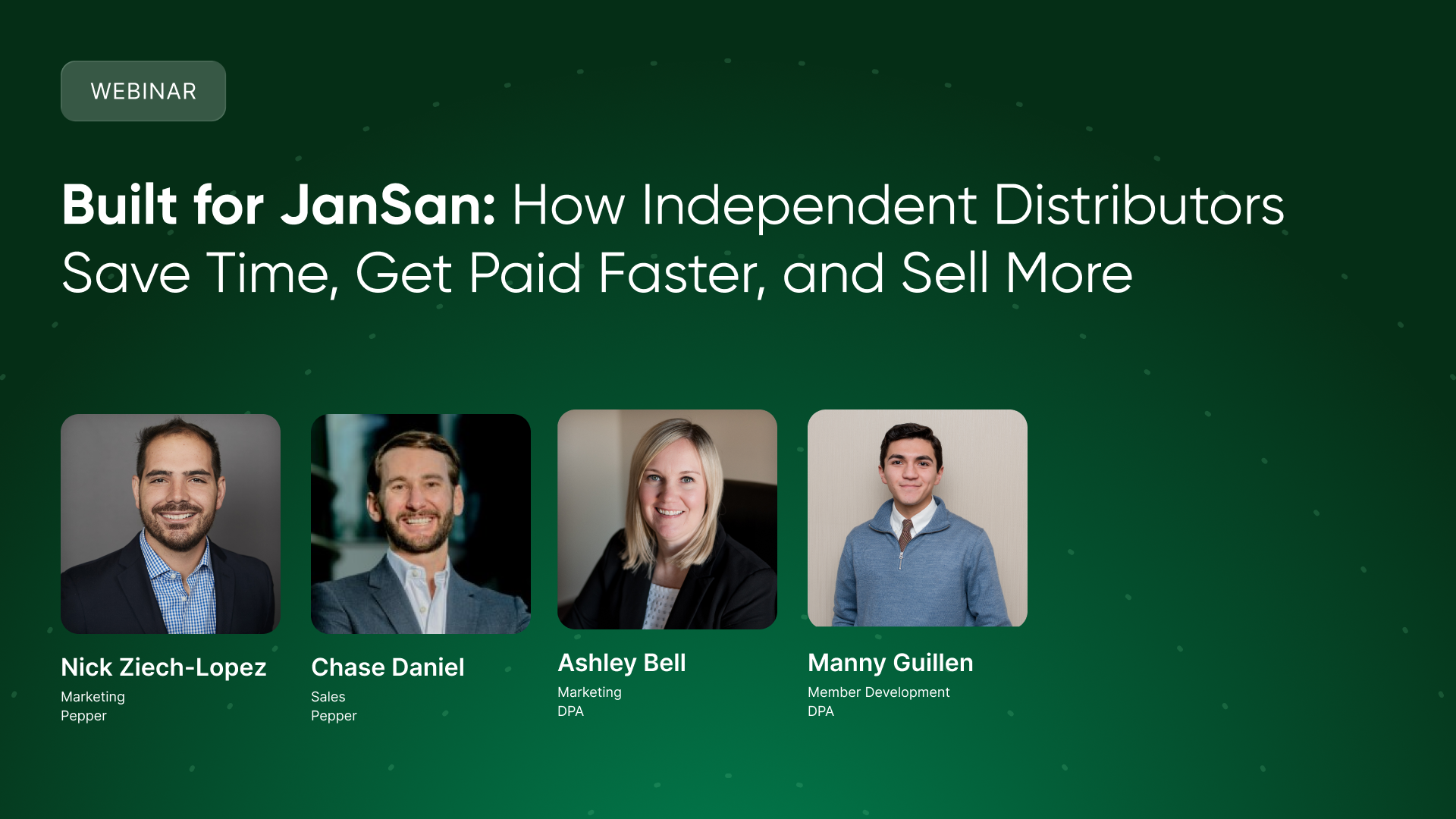
Pepper's Nick Ziech-Lopez hosted, joined by Chase Daniel (who spent years as a sales rep and truck driver for a distributor) along with Ashley Bell, VP of Marketing and Promotions at DPA, and Manny Guillen, DPA's Member Development Manager.
Chase's answer set the frame for the hour: the technology isn't there to replace the relationship. It's there to protect it. "A sales rep with AI will outcompete a sales rep without AI."
Here's what we covered.
The Headwinds DPA Members Are Facing
Ashley opened with what she's hearing from DPA's distributor members. Many are growing, but the pressure is coming from every direction at once: tariffs and rising costs that make keeping pricing current a constant chore, climbing freight and fuel costs, consolidation on both the supplier and distributor sides, and staffing shortages that make it hard to keep enough people in the business, let alone send them to trainings or shows.
At the end of the day, there are things a distributor can control and things it can't, and efficiency on the controllable side has never mattered more. That's where AI comes in, and that's where our technology makes a difference.
Price Management: Getting Ahead of Margin Instead of Chasing It
Costs are moving constantly, and pricing decisions happen by feel in the moment, while building an order, or in a homegrown spreadsheet after hours. One distributor put it bluntly: his minimum margin on any paper product should be 16 percent, but napkins still go out the door at 7 and 8 percent margin, and by the time anyone catches it, the truck is gone.
The math is the problem. It's not every item it's every item sold to every customer. The data set is too large for a person to manage.
Pepper's Price Management pulls it into one place. The cost changes view shows every item whose cost moved in the last window. Click into an item and you see your entire book of business for it: gross margin, how much recent cost changes have eaten into it, your average price, and where you sit at every single customer. From there, reps, managers, or owners can take bulk action: set a price, or bump gross margin by a couple points across a set of items or a whole customer, with room to hand-adjust the accounts where a ten-year relationship or an old contract calls for a lighter touch.
That management layer alone gives distributors back 1 to 3 points of margin on average. Then comes the AI.
The Pricing Agent analyzes your customers against their peers (accounts that look alike in what they order, how often, and how much), and surfaces the items priced below similar items at similar customers with a suggested price and an explanation of the reasoning. Cost fell and there's room to hold price. Low-velocity item that's reordered like clockwork and can carry more margin. Priced below peers. It's not black-box AI; every suggestion shows its work.
And critically, nothing changes automatically. Reps accept, adjust, or deny and those denials feed back into the model. What used to take hours after dinner now takes seconds, with the owner still in control. As Chase put it: when you're wearing every hat in a small family business, repricing is exactly the kind of work that gets pushed to another day.. and by the end of the week, you've lost margin on every sale you could have caught on Monday.
Sales Hub: A Smarter Day for the Rep
The second stop was Sales Hub, Pepper's sales enablement suite for reps on the go: accounts, orders, notes, order guides, and live order status in one place.
The AI shows up in the For You tab. Pattern detection surfaces lost items, like the account that ordered something weekly and hasn't in 36 days, alongside items of interest based on each customer's purchasing and browsing behavior. Chase was honest about what this replaces: "To my manager, I might have said I know exactly what's going on with all my accounts. But oftentimes I would miss it, or catch it too late" in a weekly review. Now the lost item is the call to action. That's the visit you make today.
Then there's Copilot, a layer of intelligence on top of the ERP that reps can simply ask questions:
- Who isn't buying cleaner from me?
- I'm seeing these accounts tomorrow — anyone nearby I can drop in on?
- Who's buying the soap but not the paper, the cups but not the lids?
It works at the rep level or the full book of business for managers, and it gets smarter about you over time, even prompting suggestions based on tomorrow's visits.
The section closed on competitive quoting: a rep handed a competitor's invoice can build a side-by-side price list against Pepper's catalog and get it to the operator by email or print on the spot. No calling the manager, no coming back tomorrow: Speed wins those moments.
Storefront: The Mobile Experience That Grows the Order
Across Pepper's 550-plus distributors, mobile is where adoption is highest. Operators are running buildings with a phone in their pocket, not sitting at a desktop.
Inside the white-label app, promotions sit front and center on the customer's home screen. The example: a supplier like Dart wants their cups pushed. The promotion can run with no discount at all as placement alone does the work, and a customer who never bought those cups adds them to the cart in one tap. Distributors running these promotions can watch it happen in the back end: Pepper reports on first-time buyers of promoted items, and the results have surprised even skeptics who doubted digital promotion would move non-food products. That's revenue that doesn't exist without the placement.
AI recommendations carry the same benefit, surfacing items based on what similar customers order and growing the average order per drop with products the account has never bought. And once an item lands in the rotation, it tends to stay there.
The prospecting workflow rounded out our session. A rep working a new territory can pull up a map of nearby businesses, claim an account so no other rep doubles up, snap a photo of a competitor's invoice (Chase used a real "big 3" invoice, live), and watch Pepper generate an order guide from it, item numbers and descriptions lined up, with prices editable right there on the phone to win the business.
For customers, the rest of the experience is deliberately omnichannel: order guide, full catalog browsing, past and upcoming orders, chat with the whole distributor team in one thread, and a centralized payments view covering ACH, card, and check - so paying on time is the easy path.
Moving Forward
Nobody is arguing that JanSan should stop being a relationship business. The argument is the opposite: every hour AI gives back on repricing, account triage, and manual order entry is an hour a rep spends in front of a customer doing the consultative work that's the whole reason operators choose an independent.
Want to see how this fits your operation? Reach out to the Pepper team for a demo tailored to your business, or connect with Nick Ziech-Lopez on LinkedIn. Thanks to our friends at DPA Buying Group for co-hosting.




.png)