


Most distributors agree that on average, they’re probably leaving at least one percentage point of margin on the table. Every sales leader we’ve spoken to has the same gut feeling: some reps are great at pricing, most aren't, and the gap between them is costing real money.
The problem has never been awareness - Distributors know that margin is slipping. They know a customer buying flatiron steaks at 4% margin is leaving money on the table when twenty comparable accounts are at 15%.
The problem is time. A sales manager can't audit 6,000 SKUs across 25 reps, and a rep running a route can't pause mid-day to cross-reference peer pricing across their entire book. And when cost changes hit (and lately they’re hitting nearly constantly) the default response is to pass the increase through and hope the customer doesn't push back. Nobody has time to ask: where could I have held a little more?
That's what Pepper’s Price Management is built to answer.
Constantly Fluctuating Costs Lead to Reactive Price Changes
The problem isn’t that reps don’t want to earn more commission, it’s that they don’t have the tools they need to stay on top of their margin.
With item costs changing nearly constantly, there are literally millions of item/customer pairs that can potentially be analyzed against similar customers to understand where prices could be increased (or should potentially be decreased). This leads most reps to make pricing decisions the same way they always have: by feel.
Each sales rep knows their top customers, they know which items are price-sensitive, and they adjust in the moment when a customer calls to say they can get ribeyes cheaper down the street. The data from our early users confirms what every distributor already suspects: Roughly 80–90% of typical in-app price edits are decreases. Reps are reacting to pressure, not finding opportunity.
Price Management flips that ratio. Among reps using the tool, 60–70% of edits are price or margin increases. And not because the tool forces increases either, as reps still accept, reject, or modify every recommendation. But because for the first time, they can actually see where the opportunities are.
Peer Range: The Data Your Best Reps Carry in Their Head
The core of Price Management is a concept called the peer range. For any item on any customer, the tool compares the margin a rep is making against what the rest of the business is earning on that same item across a comparable set of customers. When a rep is selling shrimp to one account at 7% margin and peers across the organization are averaging 16%, that gap shows up immediately.
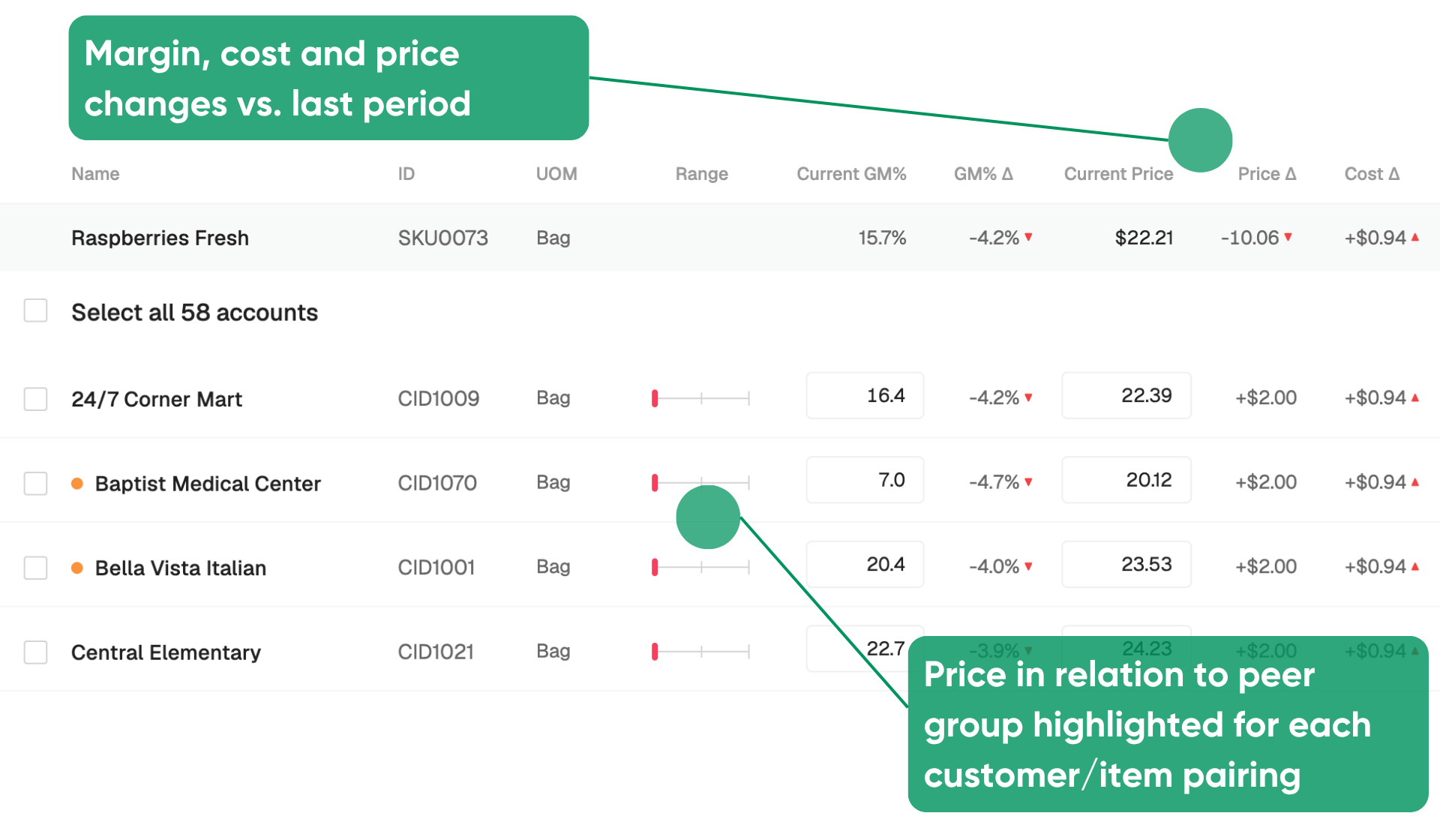
Peer groups are built from the distributor's own data — volume tiers, price tiers, and (for distributors who send customer segments through their ERP integration) the same classification logic they already use internally. The comparison is always against your own business, not an abstract industry benchmark.
This is what the best reps already do intuitively. They know their accounts, they have a mental model of what a fair margin looks like, and they adjust accordingly. Price Management takes that instinct and puts it in front of every rep on the team, but backed by data instead of feel.
Cost Changes: The Other Half of the Pricing Problem
Margin opportunities aren't just about repricing stale items. In a market where commodity costs shift weekly, every cost change is a pricing decision. When the cost on a product goes up, should the rep hold GP dollars and let margin dip? Pass the full increase through? Split the difference?
.png)
Price Management handles cost and GP% changes alongside peer-based recommendations. Cost changes surface in the same workflow with clear rationale: Here's what changed, here's what it means for margin, here's a suggested adjustment. Reps make the call, but they make it with data instead of guessing.
The Pricing Agent: Finding the Opportunities for Your Reps
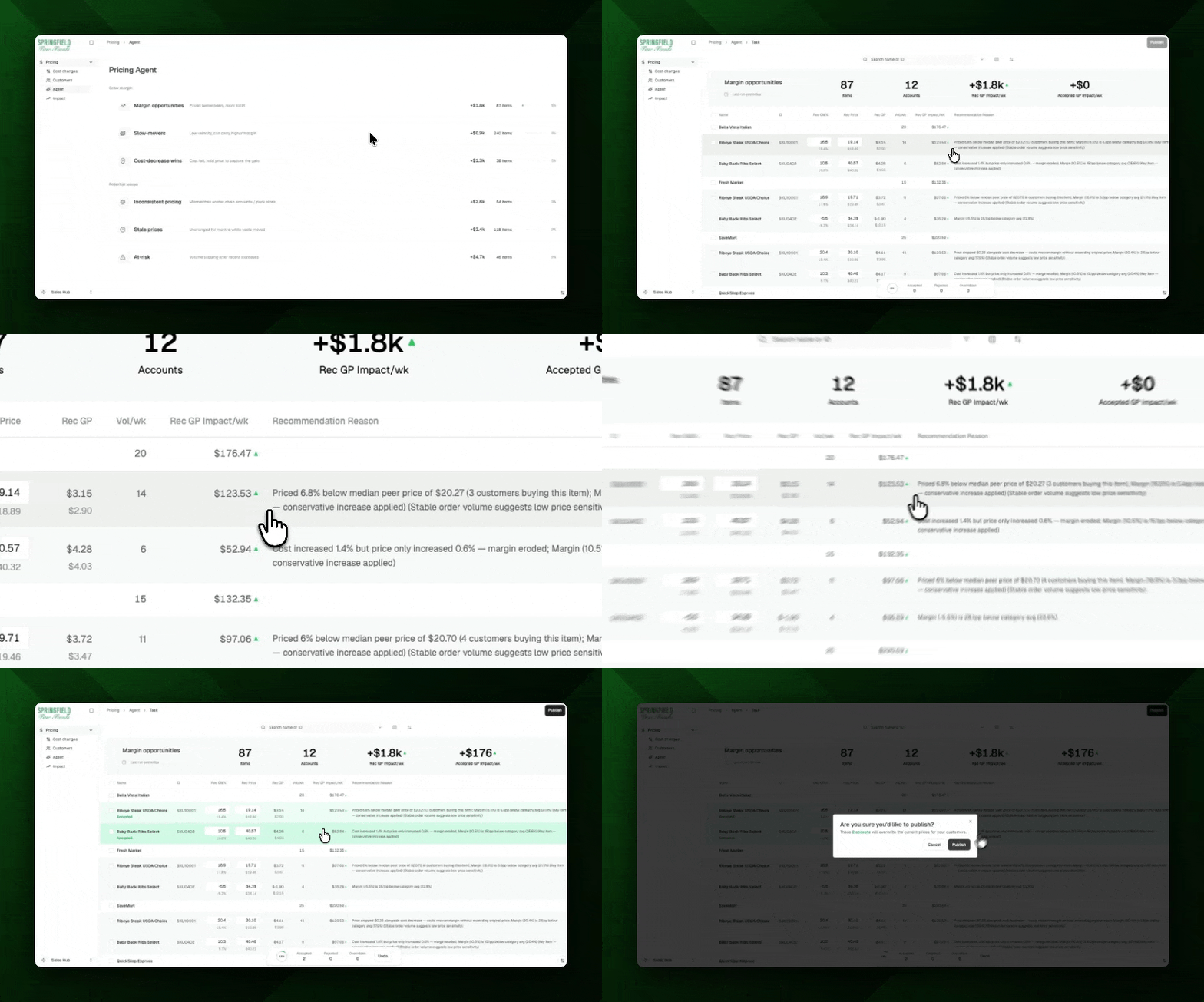
For distributors who want to go further, the AI-powered Pricing Agent automates the search entirely. The agent scans a rep's full portfolio, identifies the highest-value margin opportunities, and surfaces up to 100 specific recommendations, with each one tied to a customer, an item, a current margin, a peer comparison, and a suggested price.

Reps work through recommendations the way they'd work through a task list:
- Accept suggestions to update pricing
- Reject suggestions with dedicated reasons as to why the price is sub-optimal
- Edit the number to override with their own judgment.
When they're ready, they hit publish and the price change flows back to the ERP through Pepper's integration layer. No manual re-entry, no toggling between systems.
The agent also shows estimated GP impact for each recommendation. A rep can see, line by line, what accepting a change means in dollars per week, and what the total looks like across everything they've reviewed. Managers see the same data rolled up by rep, by category, by customer, giving them a coaching tool they've never had before.
Built Into the Platform, not Bolted On
Price Management lives inside the same Pepper app that reps already use for ordering, sales, and customer management. It's not a separate login, not a standalone dashboard, not a spreadsheet someone emails around on Mondays. Reps open Price Management the same way they open their order guide, and changes they make flow directly into the ERP through the same integration layer that powers the rest of Pepper's platform.
That matters for adoption. Every standalone pricing tool in the market has the same problem: reps don't log in. When the tool lives inside the workflow reps already use every day, adoption isn't a change management project, it's a feature they discover and start using.
Why Now?
The math is straightforward: Most distributors agree that on average, they’re probably leaving at least one percentage point of margin on the table. For a $50 million distributor, that's $500,000 a year.
For a problem of this magnitude, the root causes have always been hidden. Price Management makes them visible, the Pricing Agent makes them actionable.
And because it's built on the distributor's own data, running through the same ERP integration that already powers your Pepper deployment, there's no implementation project to stand up. For existing Pepper customers, it's activation, not implementation.
Available now
Price Management and the Pricing Agent are live and in the hands of distributors today. Early design partners — broadline distributors with reps actively using the tools — are already seeing the shift from reactive pricing to proactive margin capture.
If your reps are leaving margin on the table and you want to see where it is, reach out to your Pepper contact or talk to our team. We'll show you with your own data.
.jpg)