
Blog posts

No ERP, No Problem: How Pepper Delivers Value in an Unsteady Data Environment

When a distributor's item data lives across thirty spreadsheet tabs, a PDF catalog, and a supplier's custom numbering system, getting to launch day requires more than software: It requires a process built for the real world.

The Dirty Secret of Food Distribution Data

The assumption baked into most B2B software is that your ERP is the source of truth: Stable, current, and comprehensive. In reality, for a lot of independent food distributors, that assumption doesn't hold.

ERPs get replaced. Consider a distributor three months away from cutting over to a new system in a genuinely awkward position: their existing data is stale, their new system isn't live yet, and their customers still need to place orders tomorrow. Some distributors are mid-migration for six months or more, while others are evaluating systems entirely, running on spreadsheets and tribal knowledge while the decision gets made. In both cases, waiting until the ERP data is ready leaves money on the table - ERP migrations can’t put growth on hold.

And even for distributors with a stable ERP, the data that matters most to customers often moves faster than the system can track it. Supplier lines get added before they're fully entered. New items show up on a price sheet before anyone has touched the product master. Seasonal SKUs come and go in windows too short to justify a full integration cycle. The ERP reflects last week, and the customer needs data for today.

This is the data environment that most independent distributors actually operate in: Not broken, but perpetually in motion. And it's the environment that Pepper is built to serve.

Managing Digital Shopping Through Spreadsheets

A meaningful number of independent distributors don't fit into the ‘perfect data’ mold. Some are pre-ERP, some carry supplier lines that aren't reflected in their core system, and some have customers whose purchase behavior has never been codified anywhere beyond a rep's memory. For these distributors, waiting on a perfect integration before going live isn't a delay, It's a dealbreaker.

Pepper now meets those distributors where they are through a lightweight integration through CSV files rather than a direct ERP integration. Rather than requiring a live ERP connection, it gives distributors and their suppliers a structured upload pathway - a downloadable template, a defined set of required fields, and a delta-update mechanism that makes ongoing changes as simple as downloading the existing catalog, making a change, and uploading it back. No API credentials. No integration ticket. No three-month onboarding timeline.
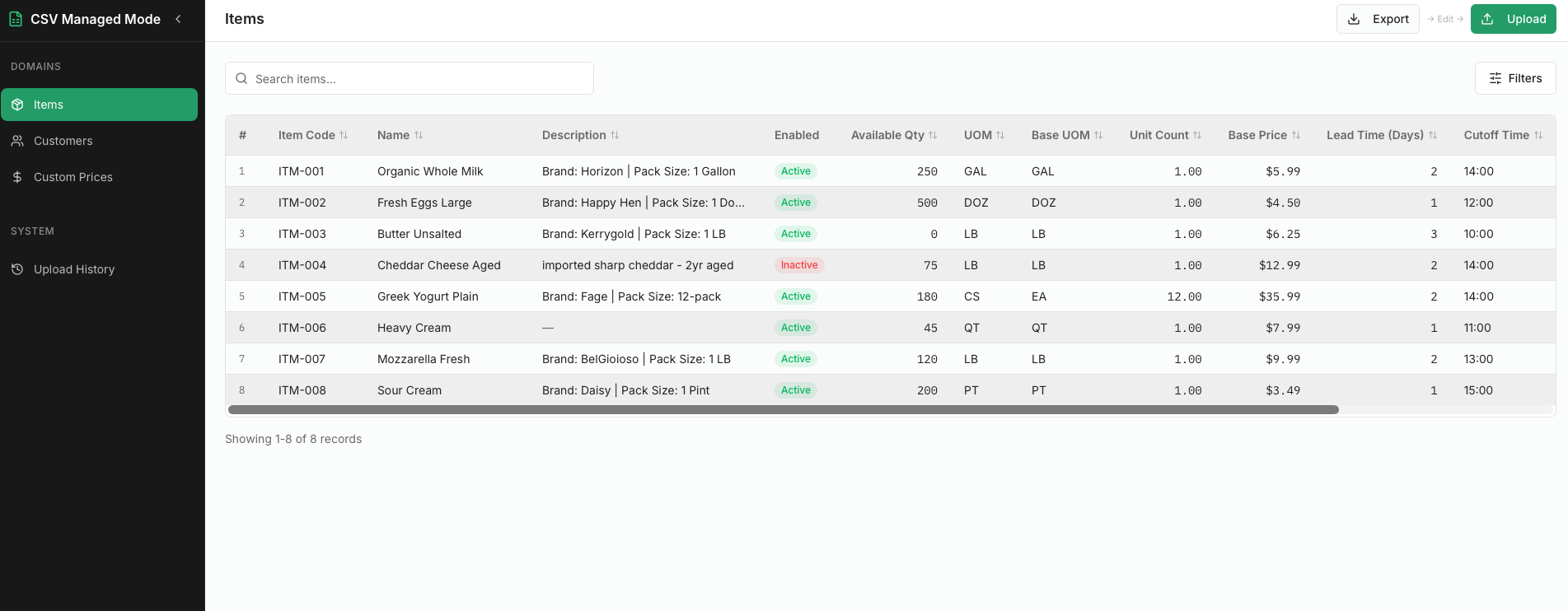
Lightweight CSV uploads allow distributors to get started with growth - fast.

One Source of Truth, Maintained Over Time

Launching the catalog is the beginning, not the end. As items get added, pack sizes change, and new supplier lines come on, a distributor running in a lightweight integration needs a sustainable process for keeping their Pepper catalog current without creating a second job for someone.

The workflow Pepper builds is endlessly maintainable: 

  • The distributor (or their supplier contact) always owns the source file. Your data, your way.
  • When something changes, they download the current catalog from Pepper, make the update, and re-upload. 
  • The system applies a delta (only the changes) rather than wiping and reloading the entire catalog. 

It's a few minutes of work, not a project.

The goal isn't to create two sources of truth, It's to make Pepper the authoritative customer-facing catalog. Fed by whatever internal data structure the distributor already has, the data handoff needs to be as low-friction as possible.

Customer Visibility Done Right

Loading all items into a catalog is only half the equation. A distributor's customers don't buy everything that distributor stocks, they buy the items available to them. A restaurant that orders exclusively from a specific supplier line, or one that uses a locked order guide, shouldn't have to scroll past two hundred irrelevant SKUs to find what they need.
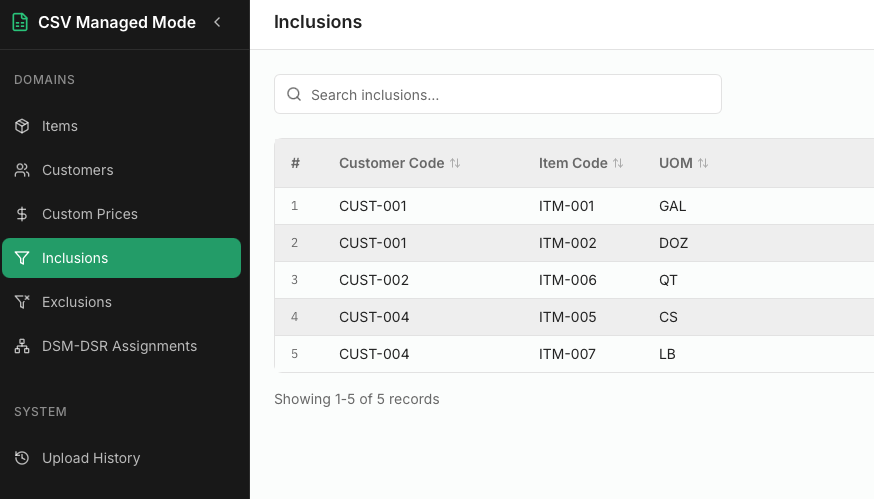
Inclusions and exclusions are critical for digital shopping

Pepper's customer-level visibility controls solve this. Once the item catalog is live, the distributor can configure each customer account to show only the products that customer buys. The distributor provides a mapping (typically a spreadsheet organized by customer name and their associated items) and Pepper uses that to filter each customer's storefront view accordingly.
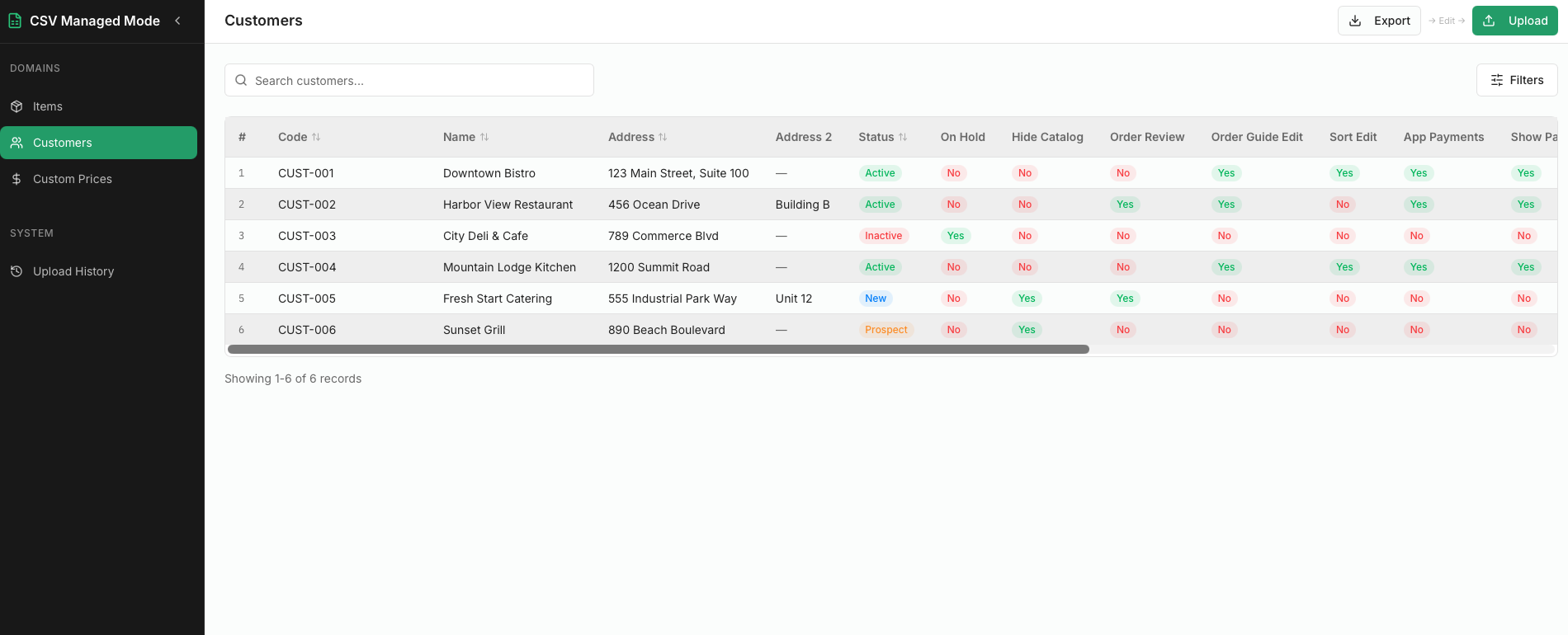
Items, customers, inclusions, exclusions - all available in the Pepper admin portal.

For end customers, this means a clean, familiar order guide that reflects how they actually do business. For the distributor, it means fewer support calls, fewer "what is this item?" questions, and an ordering experience that feels tailored rather than overwhelming.

The Path Forward

A lightweight integration isn’t just a workaround, It's an acknowledgment that the food distribution industry runs on workflows that were never designed for modern software. Getting distributors to digital doesn't require waiting for a perfect world.

As distributors grow on the platform, the data tends to get better. The translation work that happens in the early sessions (mapping item codes, building description fields, setting up customer visibility) creates a cleaner internal catalog than most distributors have ever had. That cleaner catalog becomes the foundation for everything that comes next: pricing logic, order automation, rep tools, customer analytics.

The distributors who get there aren't the ones who had their data figured out from day one. They're the ones who had an implementation process built to handle the data they actually had - and a platform that could grow with them from there.
product

Schedule a Pepper Demo today

HOMERESOURCES
Blog posts

No ERP, No Problem: How Pepper Delivers Value in an Unsteady Data Environment

Mar 13, 2026, Written by Zahfir Ayyoob

When a distributor's item data lives across thirty spreadsheet tabs, a PDF catalog, and a supplier's custom numbering system, getting to launch day requires more than software: It requires a process built for the real world.

The Dirty Secret of Food Distribution Data

The assumption baked into most B2B software is that your ERP is the source of truth: Stable, current, and comprehensive. In reality, for a lot of independent food distributors, that assumption doesn't hold.

ERPs get replaced. Consider a distributor three months away from cutting over to a new system in a genuinely awkward position: their existing data is stale, their new system isn't live yet, and their customers still need to place orders tomorrow. Some distributors are mid-migration for six months or more, while others are evaluating systems entirely, running on spreadsheets and tribal knowledge while the decision gets made. In both cases, waiting until the ERP data is ready leaves money on the table - ERP migrations can’t put growth on hold.

And even for distributors with a stable ERP, the data that matters most to customers often moves faster than the system can track it. Supplier lines get added before they're fully entered. New items show up on a price sheet before anyone has touched the product master. Seasonal SKUs come and go in windows too short to justify a full integration cycle. The ERP reflects last week, and the customer needs data for today.

This is the data environment that most independent distributors actually operate in: Not broken, but perpetually in motion. And it's the environment that Pepper is built to serve.

Managing Digital Shopping Through Spreadsheets

A meaningful number of independent distributors don't fit into the ‘perfect data’ mold. Some are pre-ERP, some carry supplier lines that aren't reflected in their core system, and some have customers whose purchase behavior has never been codified anywhere beyond a rep's memory. For these distributors, waiting on a perfect integration before going live isn't a delay, It's a dealbreaker.

Pepper now meets those distributors where they are through a lightweight integration through CSV files rather than a direct ERP integration. Rather than requiring a live ERP connection, it gives distributors and their suppliers a structured upload pathway - a downloadable template, a defined set of required fields, and a delta-update mechanism that makes ongoing changes as simple as downloading the existing catalog, making a change, and uploading it back. No API credentials. No integration ticket. No three-month onboarding timeline.

Lightweight CSV uploads allow distributors to get started with growth - fast.

One Source of Truth, Maintained Over Time

Launching the catalog is the beginning, not the end. As items get added, pack sizes change, and new supplier lines come on, a distributor running in a lightweight integration needs a sustainable process for keeping their Pepper catalog current without creating a second job for someone.

The workflow Pepper builds is endlessly maintainable: 

  • The distributor (or their supplier contact) always owns the source file. Your data, your way.
  • When something changes, they download the current catalog from Pepper, make the update, and re-upload. 
  • The system applies a delta (only the changes) rather than wiping and reloading the entire catalog. 

It's a few minutes of work, not a project.

The goal isn't to create two sources of truth, It's to make Pepper the authoritative customer-facing catalog. Fed by whatever internal data structure the distributor already has, the data handoff needs to be as low-friction as possible.

Customer Visibility Done Right

Loading all items into a catalog is only half the equation. A distributor's customers don't buy everything that distributor stocks, they buy the items available to them. A restaurant that orders exclusively from a specific supplier line, or one that uses a locked order guide, shouldn't have to scroll past two hundred irrelevant SKUs to find what they need.

Inclusions and exclusions are critical for digital shopping

Pepper's customer-level visibility controls solve this. Once the item catalog is live, the distributor can configure each customer account to show only the products that customer buys. The distributor provides a mapping (typically a spreadsheet organized by customer name and their associated items) and Pepper uses that to filter each customer's storefront view accordingly.

Items, customers, inclusions, exclusions - all available in the Pepper admin portal.

For end customers, this means a clean, familiar order guide that reflects how they actually do business. For the distributor, it means fewer support calls, fewer "what is this item?" questions, and an ordering experience that feels tailored rather than overwhelming.

The Path Forward

A lightweight integration isn’t just a workaround, It's an acknowledgment that the food distribution industry runs on workflows that were never designed for modern software. Getting distributors to digital doesn't require waiting for a perfect world.

As distributors grow on the platform, the data tends to get better. The translation work that happens in the early sessions (mapping item codes, building description fields, setting up customer visibility) creates a cleaner internal catalog than most distributors have ever had. That cleaner catalog becomes the foundation for everything that comes next: pricing logic, order automation, rep tools, customer analytics.

The distributors who get there aren't the ones who had their data figured out from day one. They're the ones who had an implementation process built to handle the data they actually had - and a platform that could grow with them from there.
Latest Posts
No ERP, No Problem: How Pepper Delivers Value in an Unsteady Data Environment
Driving Case Growth with Payments: Webinar Recap
Small Team, Big Operational Leverage: How Brown Foodservice’s Two-Person IT Team Uses AI to Punch Above Its Weight
From Showroom to Subscription: The New Playbook for Restaurant Supply Distributors
Schedule a Demo
Come see why hundreds of independent food distributors have chosen Pepper to power their eCommerce needs.
Schedule Demo

Stay Ahead with Timely Updates

Sign Up for the Latest News and Innovations Shaping the Foodservice Industry.