

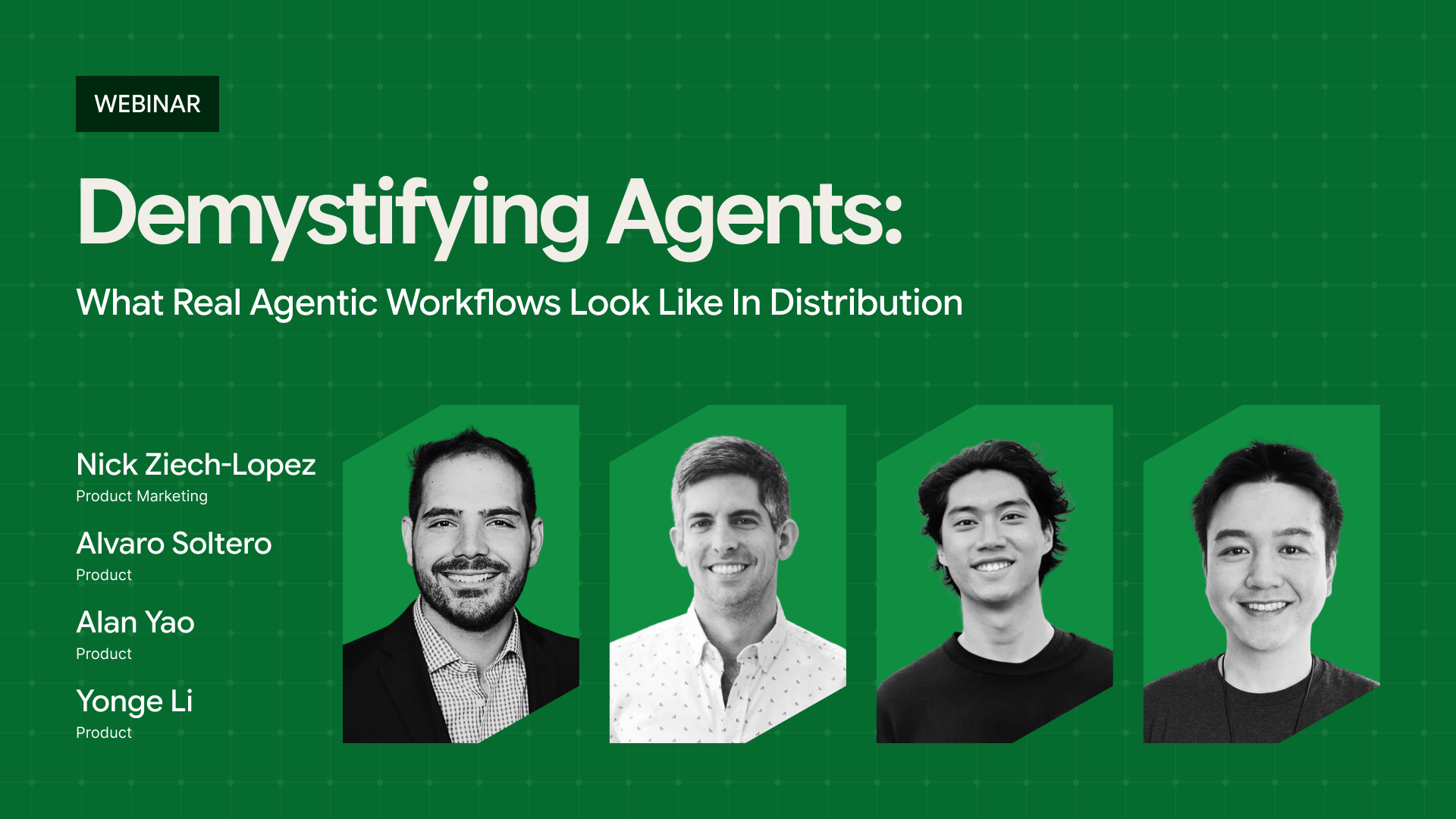


Demystifying Agents: What Agentic Workflows Actually Look Like in Distribution
Every distributor has heard the word "agent" a dozen times this year, usually without a clear picture of what any of those actually do. In this webinar, we set out to connect the dots.
I was joined by the product team to show realistic agentic workflows in distribution. Alan from Sales Hub, Yonge from Order Agent, and Alvaro from Finance Hub joined me to demo in-product workflows as they exist in Pepper today, then show the agentic version of the same job.
Here's what we covered.
What’s an Agent?
Yonge, who has been building agentic systems at Pepper for close to two years, broke it down for us.
- AI is the umbrella term covering anything from recommendation systems to self-driving software.
- A large language model is a particular kind of AI specialized in language, and it is what most people use when they ask a chatbot a question.
- An agent is a system that uses those models alongside a set of tools to complete a task that would otherwise take a person several rounds of work. It also carries permissions, so it knows which tasks it can complete on its own and which require a human.
The analogy he used was travel: A language model can tell you how to book a flight. An agent searches the flights, weighs them against your requirements, asks for your approval, and puts the itinerary in your inbox. The distinction that matters is who does the work.
Price Management Agents: Finding the Margin For You
With Price Management agents, a distributor can open any item and see how each customer's price compares against a peer group of similar customers, then adjust gross margin in bulk. Compare this with simply pulling the same view out of an ERP without any calculations or comparisons - you’re reliant on someone scrolling to find the low spots.
With the Pricing Agent, it does the scrolling for you. Six sub-agents work together to look for patterns: prices below peers, slow movers, stale prices, inconsistent pricing, and costs that fell where the price can hold. Each finding arrives with a recommended price and a written explanation of why.
The explanation isn’t a nice-to-have, it’s the whole point. Alan made the case that when an agent touches something as sensitive as price, the rep needs the reasoning as much as the recommendation. The margin gain is the outcome, but knowing this account has been priced below normal is context the rep carries into the next conversation about food cost. Recommendations can also be rejected with a reason, which is how a rep tells the system about a competitive situation the data does not show.
Order Agent Under The Hood: Working Toward Orders That Never Touch a Person
The Order Agent converts unstructured input into a structured order in the ERP. Separate sub-agents decide which date on the document is the fulfillment date, match line items by number or description, and convert pack sizes into the variants the ERP actually carries.
What the order desk sees is the evidence behind each match: whether the item is on the customer's order guide, how many times it was ordered in the last 7 days, and how many times in the last 90. That is what makes a match reviewable.
Yonge walked through a comparison the team runs internally: seven language models scored on the same messy email thread, where the customer changes the order mid-conversation and names a location that does not match anything in the system. The chart tracked how long each model took to identify the correct restaurant and how often it got it right across repeated runs.
Finance Agent: Running an AR Strategy Across the Whole Book
Alvaro showed the Finance Agent, Pepper’s AR and collections product, which is being built into a new version of Finance Hub. The rebuild is not primarily a new interface. It makes the collection functions distributors already use callable by an agent.
The new home page opens with a portfolio snapshot: total open AR, total overdue, what is due today, and average DSO across the last 90 days, followed by a customer view showing how many are on autopay, how many are reliable manual payers, how many autopay runs execute today, and how many customers have a payment method on file but are not enrolled yet.
Alvaro says that knowledge is rarely the constraint in AR collections. An AR manager with a hundred customers usually knows the nuance of all hundred situations. What they do not have is the hours to act on all of them in a day. The agent is built to execute that existing strategy across the full book rather than replace the judgment behind it. It is shipping in the coming weeks, and the team is looking for design partners.
Sales Hub: Surfacing the Opportunity Before the Visit
Alan closed with the growth work underway in Sales Hub. Reps who sell proactively already do this research, digging through year-over-year data for lost cases and studying menus for white space. The agent consolidates that work into one view of the rep's whole book.
Three sources feed it:
- Menu white space: Identified proactively rather than through the manual tool that exists in Sales Hub today.
- Operator browsing activity: Now that customers order for themselves, which surfaces intent a rep would otherwise never see.
- Recovery opportunities: The items and cases lost year over year or month over month.
When a rep accepts an opportunity, the agent recommends a specific SKU with its reasoning and proposes a next step calibrated to how strong the signal is. Low interest might mean adding the item to the order guide and watching whether it converts on its own. Higher confidence might mean sending it in chat or generating a price quote. If the best next step is an in-person conversation, the rep gets a visit brief when they arrive on site. Swapping out a recommended SKU teaches the agent something for next time.
The Through Line: Agents Earn Autonomy
The phrase that held the session together came from Alvaro: An agent earns its autonomy. Every product on the call sits at a different point on that path, and none of them start by asking a distributor for blind trust.
Pricing Agent explains its reasoning and accepts a rejection. Order Agent shows its evidence and is measuring its way toward orders that can skip review entirely. Finance Agent recommends actions and waits for the click. Sales Hub lets the rep override the SKU and learns from the override.
That is the practical answer to what an agent means in distribution. Not software that replaces the person who knows the account, but software that does the preparation, shows its work, and expands what it's trusted to do as it proves itself.