



Here's an experiment worth running: Export a year of invoice history out of your ERP, drop it into Claude or ChatGPT, and ask it where your reps are underpricing.
You'll get an answer in about twenty minutes, with item-level gaps, reps who consistently price below their peers, and categories where margin is quietly eroding. And depending on your prompt, it might even be accurate. Accurate enough that the obvious next question is: why would I pay for a product that does this?
It's a fair question, and it's one that the distributors I speak with are starting to think about. The honest answer is that the analysis genuinely isn't the hard part anymore - Frontier models are very good at finding margin patterns in a pricing file. What that twenty-minute demo hides is everything that has to happen before and after the analysis to turn it into margin you actually collect.
The Export is a Project, and the Importance of Integration
The file you dropped in probably took someone an afternoon to produce. To make it a consistent process it has to happen every week, forever, without that person.
Pricing data doesn't live in one clean table: Item cost sits in one place, customer price levels in another, contract pricing somewhere else, and lot pricing in a fourth place if you're in protein or produce.
The ERP itself then sets the ceiling on how fast you can move. Most systems in this industry weren't built to hand data to an outside tool:
- Pull limits. Some cap how often you can request data, which turns a full catalog refresh into an overnight job rather than a live feed.
- No bulk updates. Some have no way to write more than one record at a time, so a forty-item price change becomes forty separate calls.
- Missing fields entirely. Some don't expose catalog pricing, lot pricing, or contract terms through any interface at all. The data exists, but not anywhere you can reach it.
- Access restrictions. Some require network-level access or lock records while a user has them open, so pulls fail unpredictably during business hours.
Every ERP comes with its own version of that list, and you don't find out which constraints apply to you until you're three weeks into building around them.
The other constraint is the real world - A one-time export gets you a snapshot, but pricing decisions happen against costs that moved this morning. The gap between those two things is the entire difference between an interesting analysis and a usable tool.
LLMs Don’t Know Which Customers or Items are Comparable
Ask an LLM to compare a customer's price against similar customers and it will do exactly that, enthusiastically, using whatever definition of similar it can infer from the columns you gave it.
It doesn't know that the account in row 400 is a 12-unit chain on a negotiated contract, three of those customers are GPO members buying at a rate you can’t change, or that the pizza flour you’re selling to the pizza place is a competitive item and if you raised the price they would literally leave.
The peer and item set you make pricing judgements from has to exclude all of that, and the exclusions are business rules, not statistics. They live in your head and in your contracts, not in the export.
This is where DIY analysis usually dies: When a rep opens the recommendation, spots one obviously wrong comparison, and decides the whole thing is noise.
Reps Don’t Work in a Chat Window - Accepting a Recommendation Has to Mean Something
The output of a DIY analysis is a table. Somebody then has to get that table in front of forty reps, in a form they'll act on, and measure to see what happened.
Emailed spreadsheets don't survive contact with a sales force because a spreadsheet asks a rep to stop what they're doing, cross-reference an account list, decide what to change, and then go make the changes somewhere else. Every one of those steps sheds users.
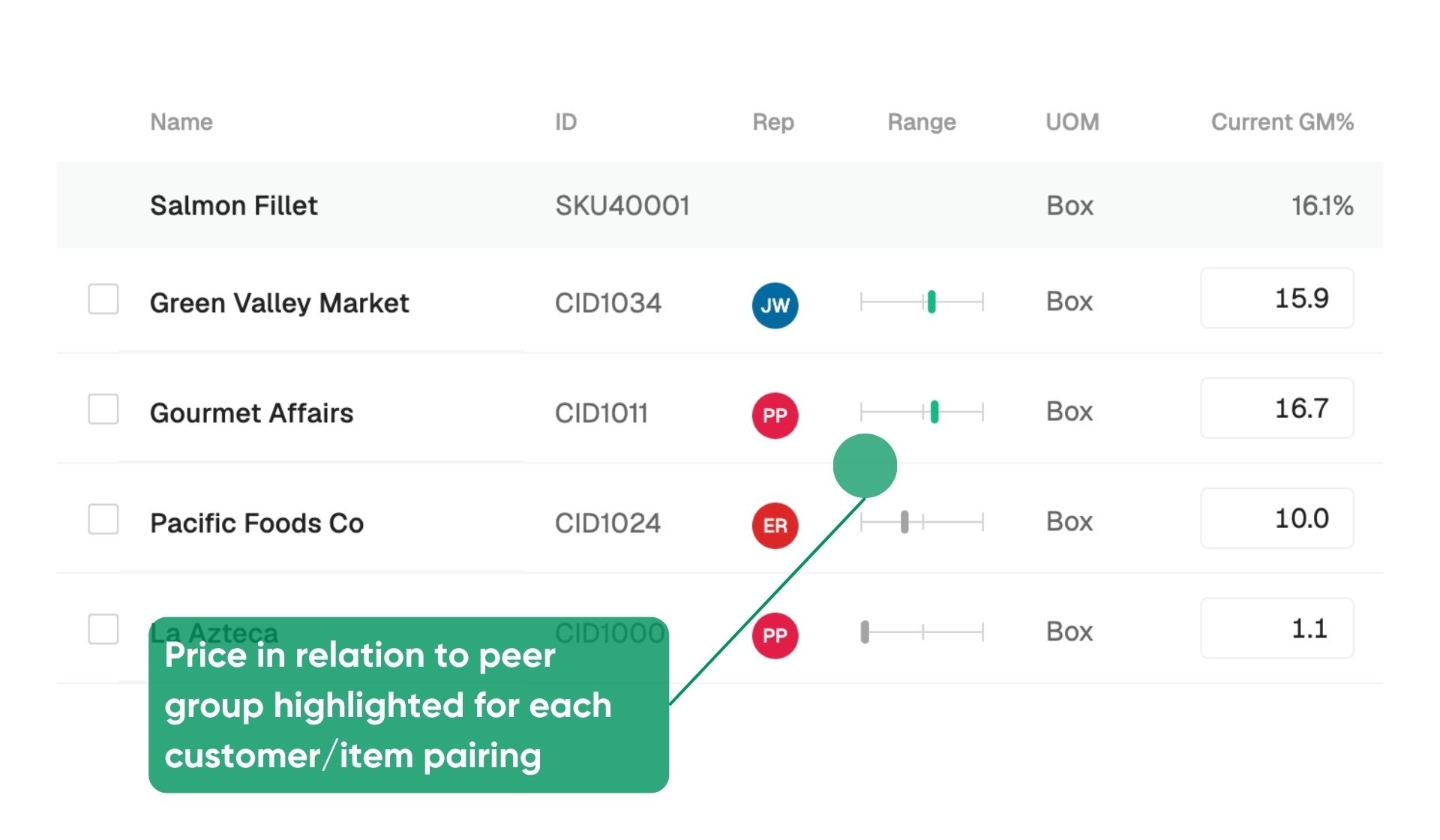
The version that works puts the opportunity inside the tool the rep already opens to build orders, on their phone, with the customer's account already loaded. That's not a nicety layered on top of the analysis. It's the part that determines whether any margin gets captured at all.
But say a rep agrees with all forty items you surfaced. Now what?
In a DIY workflow, now they key forty changes into the ERP by hand… Then another analysis lands the next week and they have to do it again. The amount of time it takes to even act on the analysis is impossible to keep up with.
Write-back is the unglamorous half of the round trip: a rep accepts, modifies, or rejects, and the change posts to the ERP without anyone retyping it. It's also the only way you get a record of what was recommended, what was acted on, and which reps are actually engaging — which is what a sales manager needs to run the program at all.
The Real-World Behavior Shift
In the data we’ve observed over the last few years, we see that when reps adjust pricing reactively (mid-order, after a customer pushes back) 80–90% of those edits are margin decreases. When the same reps work proactively through Price Management, 60–70% of edits are margin increases. Same reps, same accounts, same costs. The only variable is whether they saw the opportunity before the conversation or during it.
Flanagan Foodservice, one of Canada's largest broadline distributors, has Price Management and the Pricing Agent running across its sales organization. "The guys who are actually fully into it, I'm seeing a one to two percent margin increase," says Dave Penrith, VP of Street Sales.
By creating a process that makes it easy for reps and managers to see and react to suggestions, the adoption naturally increases because everyone wants to make more. It’s not just the analysis that creates the adoption - it’s the embedded workflow and ability to trust what the tool is giving them.
Try it Yourself
We mean this. If you're wondering what would happen, run the export and the analysis. It's the fastest way to find out whether the opportunity in your book is big enough to be worth a program - And if it isn't, you've saved yourself a purchase.
What you'll find is that the analysis confirms the opportunity exists and gives you no mechanism to capture it. That's the real shape of the build vs. buy question. It isn't a question of whether AI can find margin in your data: It can. It's whether the finding is connected to your ERP, your peer logic, your reps' phones, and your price levels every week, without a person holding it together.
The model isn't where the value is found. The product around it is.