

Alpha Eagle has reinvented itself every few years - but the latest headwinds in Jansan distribution are difficult to navigate: Customers no longer care where a product is made. They check every quote against Amazon, and they can move to a competitor without a single phone call.
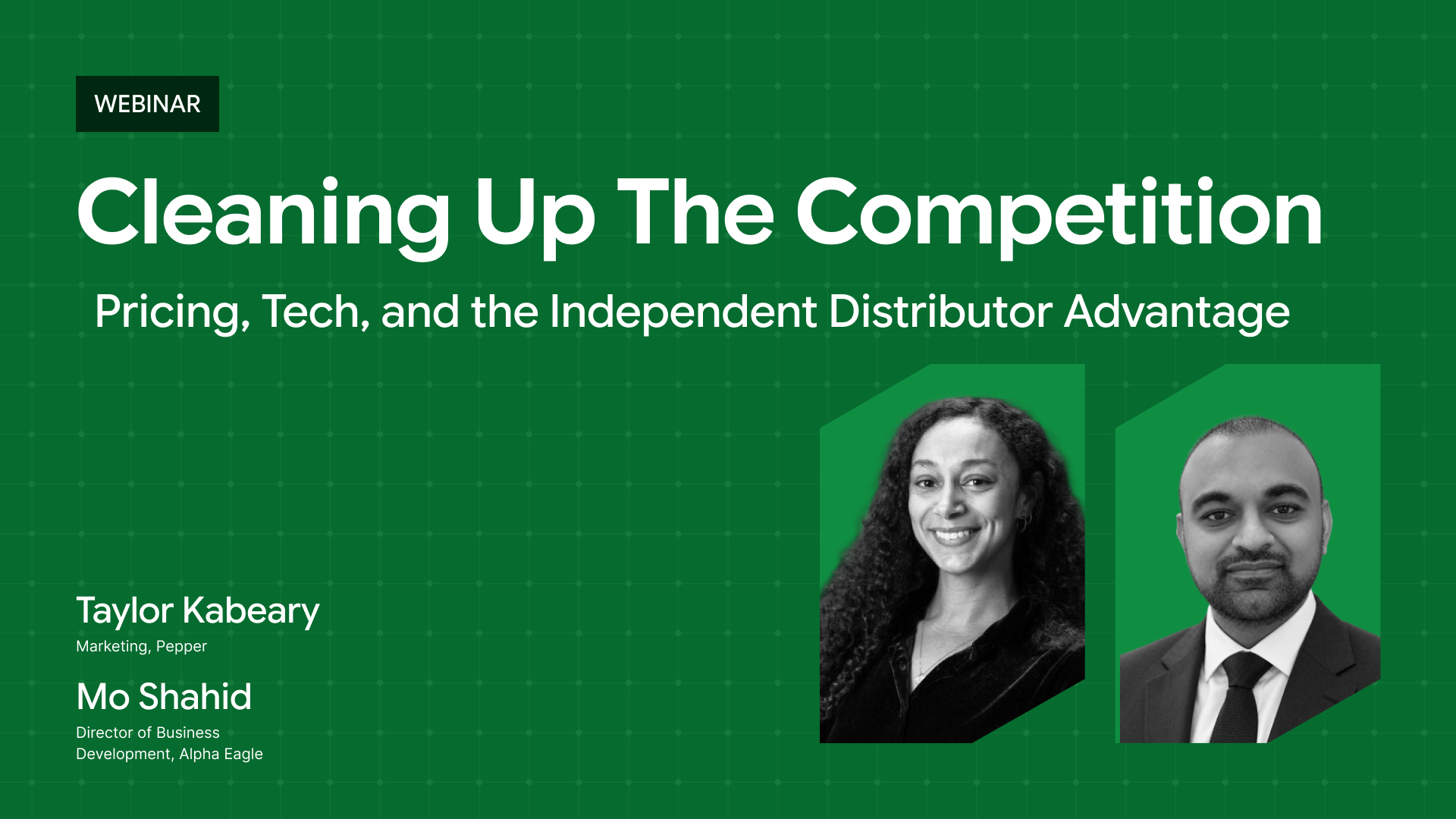
When I sat down with Mo Shahid for our latest webinar, he walked me through what this shift has meant for his business and how Pepper helps him navigate the new customer paradigm. His answer: stay more flexible than the big players can, and back every customer conversation with data.
Here's what we covered.
From Food Packaging to (Nearly) Every Industry
Mo started with an overview of Alpha Eagle’s beginnings as a supplier of basic food packaging to single-unit restaurants and convenience stores, with very few SKUs. The catalog widened in the early '90s, but the biggest change came during SARS, which hit Canada hard and shook the core business. Grocery stores started calling for product, and from there the catalog grew into cleaning products, packaging, prepared foods, washroom hygiene, PPE, and sanitizers.
Every expansion for Alpha Eagle started with existing customers asking what else they could do. Serving nearly every industry it can is how the business stays on an even keel when any one market turns.
Big Changes in the Business with Big Changes in the World
For decades, Alpha Eagle's point of pride was selling only Canadian- and US-made products. During COVID, customers had no choice but to take product from Mexico, China, and Thailand.
What Mo didn't expect was what happened after supply chains stabilized. Customers stayed flexible on vendor, product line, and even substrate. The upside is that customers will now try new things.
Consolidation Cuts Both Ways
Consolidation has turned some small, uncompetitive rivals into real threats, with new scale and much better buying. At the same time, the competitors that got rolled up have become less flexible as part of a much larger machine. Mo was candid that mom-and-pop accounts have gotten harder to win, so Alpha Eagle is more selective about where it competes. It focuses on customers who value what it brings, "and that's not everybody at the end of the day."
The First Price Has to Be the Best Price
Before Pepper, Alpha Eagle had no online ordering - but it is now what lets the business go toe-to-toe with larger distributors and broadliners. The trade-off is price transparency, and Mo said the old playbook of opening high and negotiating down is gone, so the first price has to be the best price.
I asked how hard it is to win a customer back once they've bought somewhere else. Very. A competitor who gets in starts adding SKUs and working the rest of the account. "We can't give even one inch to a competitor."
Finding the Margin Leaks and Using Reporting
Robust reporting is needed to cover blind spots in margin and customer touch points. Mo uses Pepper's dashboards and exports weekly and monthly reports into Claude and ChatGPT. He asks a report on what trends stand out and which SKUs have fallen off at which customers.
His favorite Pepper report shows customers who ordered in the last 30 days but not the last 14. He pulls everyone at 14 or 15 days without an order and sends the list to reps for follow-up. Online ordering made reps' lives easier, Mo said, but it added a job: making sure they actually follow up. A rep sees a customer's orders coming in often, and "often" might mean three weeks ago.
What to Do in the Next 12 Months
Mo's closing view: the market has become a battle of who has the most technology. Alpha Eagle competes with Costco Business Centers, Amazon, and broadliners operating across Canada and the US, each with many levers to pull. A business once built purely on relationships now needs data behind every customer conversation: you stopped buying this, this dropped off, what can we do better?
My takeaway? data, data, data. It puts an independent on the same playing field as the giants, and personal relationships are still the edge.