Blog posts

AI in Foodservice: Distributor Spotlight on Merit Foods of Arizona

How Merit Foods Is Using AI to Solve Real Operational Problems

The examples of what AI looks like in foodservice often feel abstract: Big promises, future-facing concepts, and tools that sound impressive but hard to apply. But at Merit Foods of Arizona, AI adoption looks very different - it’s practical, grounded, and focused on solving specific problems that independent distributors have lived with for decades.

To highlight a specific AI success story in distribution, we spoke with Ryan Sadowsky, Business Analyst at Merit Foods, about how his team is using AI today. Not as a replacement for people or systems, but as a way to extend what a lean team can realistically build and manage.

A Distributor with Unique Complexity

Merit Foods is a broadline distributor that also processes center-of-the-plate proteins, including custom cuts. That added layer introduces complexity most distribution software isn’t designed to handle.

Standard ERP and warehouse management systems work well for receiving, storage, and fulfillment. They struggle, however, when production variables enter the picture: yield loss, cutter labor, packaging costs, time-on-task, and constantly changing inbound protein prices.

For years, much of this was handled manually.

“We were writing weights down on pink paper,” Ryan explained. “Someone would jot it down, and who knows who would look at it afterward.”

Pricing decisions relied heavily on experience and judgment. Sometimes they were accurate. Sometimes not. But there was no systematic way to understand true cost at the item level.

Building or buying a full production management system didn’t make sense either - Merit isn’t a retail processor. They needed something lighter, purpose-built, and flexible.

Building What Didn’t Exist With AI’s Help

Ryan joined Merit Foods after graduating with a degree in information systems. When he was handed stacks of handwritten yield notes and asked a simple question: “Can you tell us if we’re making money in this room?” he started building.

The first version of the system focused on yield testing. Inbound protein cases are scanned by UPC. Outbound weights are scanned after processing. Yield is calculated automatically.

From there, the system expanded quickly:

  • Labor time is tracked via a stopwatch assigned to the cutter performing the work
  • Packaging costs (bags, boxes) are included
  • ERP pricing is pulled in for comparison
  • A real-time dashboard shows actual cost versus current price and recommended adjustments
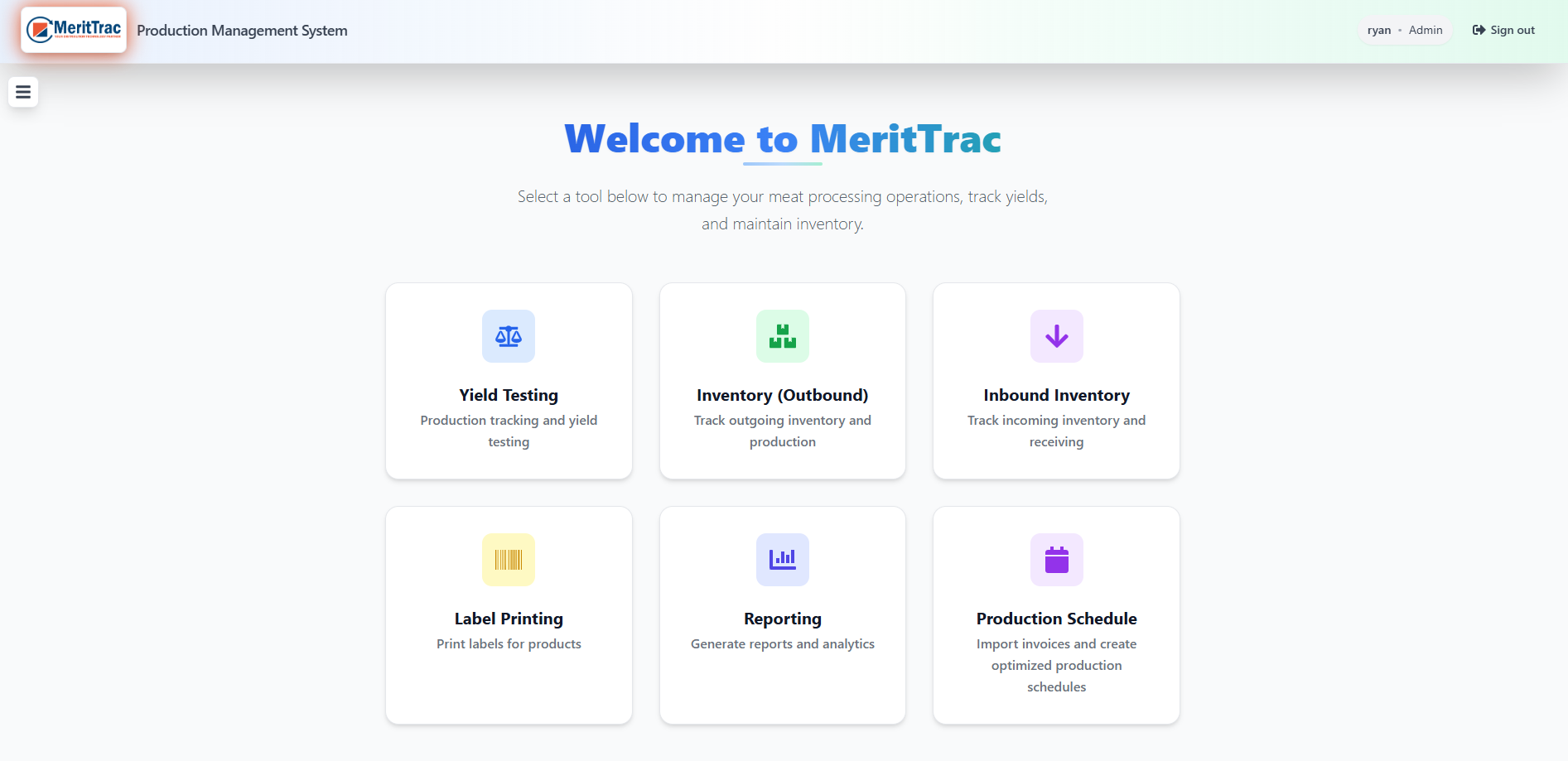
Ryan built for what his ERP didn’t offer, from the ground up.

“The lower the yield, the higher the price—but complexity matters too,” Ryan said. “How long it took, who cut it, what materials were used. You finally get a real picture.”

AI played a critical role throughout this process. Ryan didn’t use it to replace engineering judgment, he used it to move faster. Debugging code, cleaning up logic, thinking through edge cases, and even designing interfaces where he didn’t consider himself strong.

The development team, as Ryan put it, was “me and AI.”

Optimizing the Warehouse and the Employee Experience

After seeing success applying AI to center-of-the-plate production, Merit Foods began extending the same problem-solving mindset into the warehouse. One of the most immediate opportunities was slot optimization, a challenge many distributors recognize but rarely address systematically.

Like many facilities, Merit’s warehouse had grown organically over time. High-pick items were scattered across aisles, fast movers weren’t always in ground slots, and pick paths weren’t optimized for how customers actually order. The result was excess walking, inefficiency, and avoidable mispicks.

Rather than relying on gut feel, Ryan began building an AI-assisted model that looks at multiple data points at once: item velocity, pick frequency, and which items are consistently purchased together. The goal wasn’t just to move fast-moving items closer to the floor, but to strategically place complementary products near each other, reducing walk time between picks.

“What started as ‘let’s consolidate high picks’ turned into a ranking system,” Ryan explained. “Once you start looking at velocity and what items move together, you realize you can design the warehouse around actual buying behavior.”

But operational efficiency wasn’t the only area Ryan explored.

On the other end of the spectrum, he began experimenting with AI to enhance the employee experience, specifically, how connected employees feel to the customers they serve. The result is a side project he calls “Dine & Discover.”

Dine & Discover is an internal, employee-only app that functions like a Yelp-style experience for Merit Foods’ customers. Employees can log visits to restaurants, take photos, and share experiences.
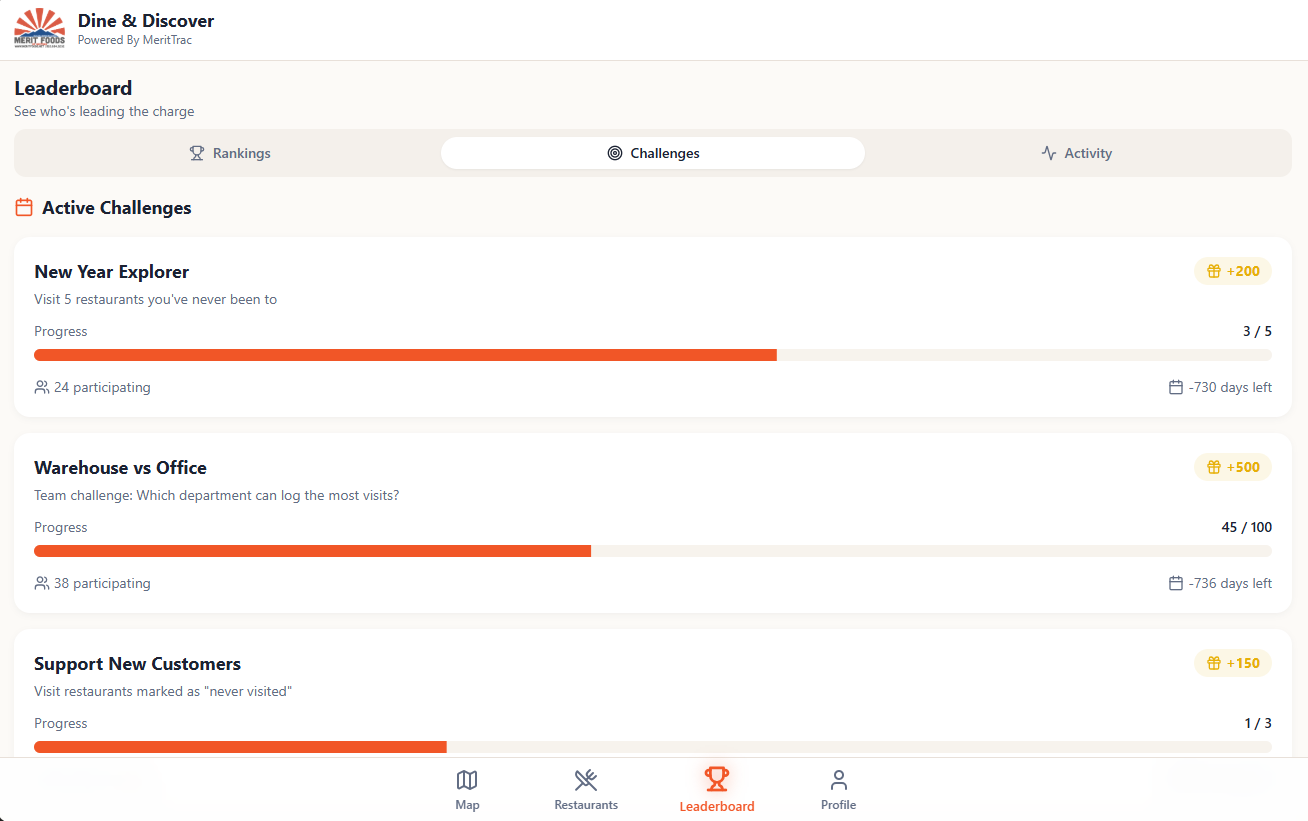
AI as a means of promoting employee engagement

“It’s about showcasing our customers to our employees,” Ryan said. “Helping people feel more connected to where our food actually ends up.”

Built with the help of AI development tools, the app isn’t live yet, but it reflects a broader theme in Merit’s AI journey. AI isn’t just being used to squeeze more efficiency out of operations. It’s being used creatively, in the background, to prototype ideas that strengthen culture, engagement, and long-term connection to the business.

Teaching AI as a Skill, Not a Tool

What stands out most about Merit Foods’ approach is how intentionally AI is being adopted internally. This isn’t about plugging in a black box.

Ryan has emphasized training teams on how to work with AI—how to ask better questions, evaluate outputs critically, and apply it to communication, analysis, and creativity while protecting company data.

“AI isn’t there to take my work away,” Ryan said. “It’s there to enhance my work.”

That mindset is key. The biggest unlock isn’t technical ability, it’s actually recognizing which problems are now solvable and being willing to rethink old constraints.

No items found.

Schedule a Pepper Demo today

HOMERESOURCES
Blog posts

AI in Foodservice: Distributor Spotlight on Merit Foods of Arizona

Feb 03, 2026, Written by Pepper Team

How Merit Foods Is Using AI to Solve Real Operational Problems

The examples of what AI looks like in foodservice often feel abstract: Big promises, future-facing concepts, and tools that sound impressive but hard to apply. But at Merit Foods of Arizona, AI adoption looks very different - it’s practical, grounded, and focused on solving specific problems that independent distributors have lived with for decades.

To highlight a specific AI success story in distribution, we spoke with Ryan Sadowsky, Business Analyst at Merit Foods, about how his team is using AI today. Not as a replacement for people or systems, but as a way to extend what a lean team can realistically build and manage.

A Distributor with Unique Complexity

Merit Foods is a broadline distributor that also processes center-of-the-plate proteins, including custom cuts. That added layer introduces complexity most distribution software isn’t designed to handle.

Standard ERP and warehouse management systems work well for receiving, storage, and fulfillment. They struggle, however, when production variables enter the picture: yield loss, cutter labor, packaging costs, time-on-task, and constantly changing inbound protein prices.

For years, much of this was handled manually.

“We were writing weights down on pink paper,” Ryan explained. “Someone would jot it down, and who knows who would look at it afterward.”

Pricing decisions relied heavily on experience and judgment. Sometimes they were accurate. Sometimes not. But there was no systematic way to understand true cost at the item level.

Building or buying a full production management system didn’t make sense either - Merit isn’t a retail processor. They needed something lighter, purpose-built, and flexible.

Building What Didn’t Exist With AI’s Help

Ryan joined Merit Foods after graduating with a degree in information systems. When he was handed stacks of handwritten yield notes and asked a simple question: “Can you tell us if we’re making money in this room?” he started building.

The first version of the system focused on yield testing. Inbound protein cases are scanned by UPC. Outbound weights are scanned after processing. Yield is calculated automatically.

From there, the system expanded quickly:

  • Labor time is tracked via a stopwatch assigned to the cutter performing the work
  • Packaging costs (bags, boxes) are included
  • ERP pricing is pulled in for comparison
  • A real-time dashboard shows actual cost versus current price and recommended adjustments
Ryan built for what his ERP didn’t offer, from the ground up.

“The lower the yield, the higher the price—but complexity matters too,” Ryan said. “How long it took, who cut it, what materials were used. You finally get a real picture.”

AI played a critical role throughout this process. Ryan didn’t use it to replace engineering judgment, he used it to move faster. Debugging code, cleaning up logic, thinking through edge cases, and even designing interfaces where he didn’t consider himself strong.

The development team, as Ryan put it, was “me and AI.”

Optimizing the Warehouse and the Employee Experience

After seeing success applying AI to center-of-the-plate production, Merit Foods began extending the same problem-solving mindset into the warehouse. One of the most immediate opportunities was slot optimization, a challenge many distributors recognize but rarely address systematically.

Like many facilities, Merit’s warehouse had grown organically over time. High-pick items were scattered across aisles, fast movers weren’t always in ground slots, and pick paths weren’t optimized for how customers actually order. The result was excess walking, inefficiency, and avoidable mispicks.

Rather than relying on gut feel, Ryan began building an AI-assisted model that looks at multiple data points at once: item velocity, pick frequency, and which items are consistently purchased together. The goal wasn’t just to move fast-moving items closer to the floor, but to strategically place complementary products near each other, reducing walk time between picks.

“What started as ‘let’s consolidate high picks’ turned into a ranking system,” Ryan explained. “Once you start looking at velocity and what items move together, you realize you can design the warehouse around actual buying behavior.”

But operational efficiency wasn’t the only area Ryan explored.

On the other end of the spectrum, he began experimenting with AI to enhance the employee experience, specifically, how connected employees feel to the customers they serve. The result is a side project he calls “Dine & Discover.”

Dine & Discover is an internal, employee-only app that functions like a Yelp-style experience for Merit Foods’ customers. Employees can log visits to restaurants, take photos, and share experiences.

AI as a means of promoting employee engagement

“It’s about showcasing our customers to our employees,” Ryan said. “Helping people feel more connected to where our food actually ends up.”

Built with the help of AI development tools, the app isn’t live yet, but it reflects a broader theme in Merit’s AI journey. AI isn’t just being used to squeeze more efficiency out of operations. It’s being used creatively, in the background, to prototype ideas that strengthen culture, engagement, and long-term connection to the business.

Teaching AI as a Skill, Not a Tool

What stands out most about Merit Foods’ approach is how intentionally AI is being adopted internally. This isn’t about plugging in a black box.

Ryan has emphasized training teams on how to work with AI—how to ask better questions, evaluate outputs critically, and apply it to communication, analysis, and creativity while protecting company data.

“AI isn’t there to take my work away,” Ryan said. “It’s there to enhance my work.”

That mindset is key. The biggest unlock isn’t technical ability, it’s actually recognizing which problems are now solvable and being willing to rethink old constraints.
Latest Posts
Turning Payments Into a Growth Engine for Distributors
AI in Foodservice: Distributor Spotlight on Merit Foods of Arizona
Selling Blind Is Expensive: Now DSRs Can See Their Commissions as They Sell in Pepper.
Streamlining Orders with Pepper’s AI Order Automation: Order Agent
Schedule a Demo
Come see why hundreds of independent food distributors have chosen Pepper to power their eCommerce needs.
Schedule Demo

Stay Ahead with Timely Updates

Sign Up for the Latest News and Innovations Shaping the Foodservice Industry.